
You probably know that periods come every month, but did you know that your menstrual cycle isn't always exactly one month long? For example, if you get your period on 14th March, it doesn't mean you'll get it again on 14th April, 14th May and 14th June. So, if not a month, how many days is a menstrual cycle, then?
01 How many days are between periods?
The average menstrual cycle lasts 28 days. Your period can last between 21 and 35 days.
The length of your menstrual cycle can vary slightly from month to month as our bodies don't always follow a regular schedule.
Knowing how many days your menstrual cycle lasts is essential for determining when your next period will arrive. No one wants to be caught off guard by an unexpected period.
02 How to calculate your menstrual cycle?
Here's how to calculate the number of days in your average cycle:
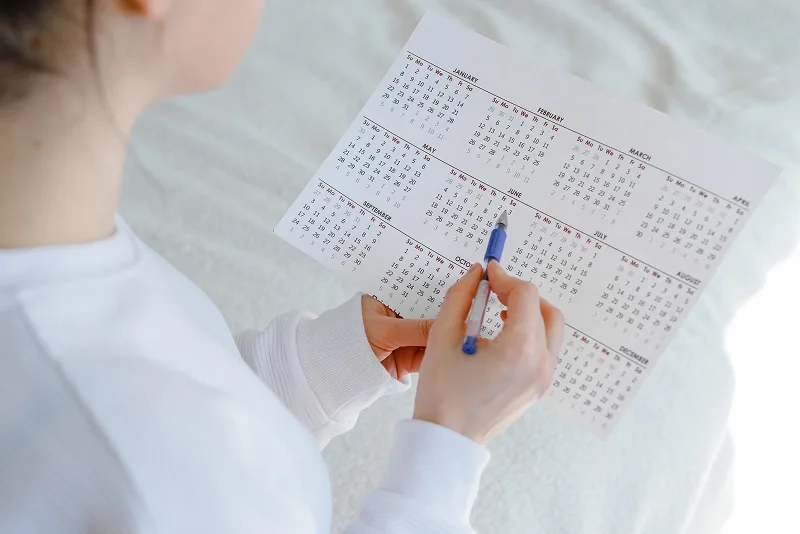
- Mark the day your period arrives on a calendar. This is day one of your menstrual cycle.
- From this date, count each day until your next period arrives.
This will tell you the number of days in your menstrual cycle. If your next period is on a Thursday, Wednesday will be the last day of your previous period. If you do this for several months in a row, you will find the average number of days in your menstrual cycle, or your average menstrual cycle. If you don't want to do the maths yourself, you can use our Period Tracker.
Simply, enter your period start and end dates, and the tracker will do the rest.
Your periods may be a little irregular at first, which means your menstrual cycle won't be predictable. It can take some time for your body to get used to the hormonal changes it's going through. Your menstrual cycle length should stabilise after about a year.
03 Menstrual cycle phases: How often do periods occur?
Although it may take some time for your menstrual cycle to stabilise, it's important to know that it consists of four distinct phases, regardless of its length.
Phase 1: Menstruation
This phase marks the beginning of the menstrual cycle. The lining of the uterus (endometrium), which had thickened in preparation for a possible pregnancy, is shed and leaves the body as menstrual fluid. This fluid consists of blood, tissue and mucus. Menstruation typically lasts between three and seven days, but this can vary.
Phase 2: Follicular Phase
The follicular phase overlaps with menstruation and continues after it ends. During this phase, the pituitary gland releases follicle-stimulating hormone (FSH), which signals the ovaries to develop several follicles — small sacs that each contain an immature egg. Usually, only one follicle will mature fully. At the same time, oestrogen levels rise, causing the uterine lining to thicken again in preparation for a potential pregnancy.
Phase 3: Ovulation
Ovulation occurs when the mature egg is released from the ovary. This typically happens around 14 days before the start of the next period — not always on day 14 of the cycle, but 14 days before the next menstruation begins, regardless of cycle length.
Example:
- 28-day cycle → ovulation around day 14
- 22-day cycle → ovulation around day 8
After release, the egg travels through the fallopian tube toward the uterus. If sperm fertilise the egg, pregnancy may begin. The ovaries usually alternate releasing an egg each month.
Phase 4: Luteal Phase
After ovulation, the empty follicle transforms into the corpus luteum, which produces progesterone. This hormone maintains the thickened uterine lining in case a fertilised egg implants. If fertilisation does not occur, the corpus luteum breaks down, progesterone levels drop, and the uterine lining begins to disintegrate. This hormonal change can cause premenstrual symptoms such as cramping or abdominal discomfort. The cycle then restarts with menstruation.
04 Preparing for your period
Before the onset of your next menstrual period, you may choose to use a form of light sanitary protection, such as liners.
A panty liner is a thin absorbent sheet that adheres to the inside of the underwear and is designed to absorb vaginal discharge or the first traces of menstrual blood.
Using a panty liner can help maintain hygiene, reduce moisture, and protect underwear from staining in the premenstrual phase.
This can be especially useful when hormonal changes cause an increase in cervical mucus or when menstrual bleeding begins unexpectedly.
Tracking the length of your menstrual cycle also allows you to prepare adequately — for example, by carrying period pads in your bag or keeping them in your locker — so you are equipped and prepared once menstruation starts.
Pads exist in different sizes. Smaller sizes are recommended for light to moderate bleeding. Bigger sizes are suitable if you have heavier periods.